AnaROS · The Rack Operating System

One runtime. For the rack — and the pipeline beyond it.

AnaROS turns a rack full of heterogeneous CPUs, GPUs, fabric, and storage into a single governed system — and extends the same operating contract across racks, clouds, and providers as the pipeline crosses them. Four lenses, one storyline — Visibility, Traceability, Governance, and Workload Placement — built on multi-tier telemetry that goes from L4 application workflow down to L1 fabric, and follows the pipeline wherever it lands.

01 · VISIBILITY
The vertical stack
See L4 → L3 → L2 → L1 at once. Workflow, pipeline, fabric, racks — one picture.
02 · TRACEABILITY
The horizontal pipeline
Walk the pipeline X-Ray. Intra-node, inter-node, fabric. Victim vs. root cause.
03 · GOVERNANCE
Live resource map
Every GPU, every model, every pipeline accounted for — ledger vs. reality.
04 · PLACEMENT
Workloads on the right silicon
Stages routed to the cheapest GPU class that holds their SLO. Discover to Govern.
CHAPTER 01

Visibility — the vertical stack.

Why four layers?

A single AI call traverses your application code → runtime → GPU → fabric → storage in milliseconds. When p99 collapses, the symptom you see at the top — a slow agent, a stuck retrieval, a timeout — usually has its root cause four layers down: a NIC buffer overflow, a NUMA miss, a noisy neighbor in another tenant. The dashboards you have today don't connect: K8s knows the pods, CUDA knows the kernels, the network team owns the spine — none of them see across boundaries.

AnaROS gives the rack one vertical view.

Four cooperating layers — L4 workflow, L3 pipeline X-ray, L2 logical fabric, L1 physical rack — visible from one operator surface. Trace any workflow top-to-bottom in a single pane, and the symptom and the root cause finally show up on the same screen. Scroll to drill into each layer.

L4 Application Workflow

The workflow your business actually runs.

Agentic flows, MoE applications, inspection pipelines — expressed as a controlled workflow graph with steps, branches, loops, and SLOs. This is the surface CIOs and product owners reason about.

  • Unit of work: the pipeline, not the GPU box
  • Inputs: intent, data sources, SLOs, tenant scope
  • What you see: 6 nodes · branch + merge · per-node host
  • Why it matters: outcomes are owned by the workflow
L3 Pipeline Infrastructure

One pipeline. Heterogeneous rack. Mixed GPU classes. Governed.

AnaROS decomposes each workflow into Ingest, Preparation, Execution, and Persistence across network, compute, memory and storage — and routes each stage to the right fit GPU class that holds its SLO. Heavy CNN/ViT inference doesn't mean every stage needs an H200.

  • Stages: Ingest · Prep · Execution · Persistence
  • Routing: per-stage GPU class (T4 · L4 · L40S · H200)
  • Telemetry: p95/p99, drift, queue depth, chargeback
  • Why it matters: 60-80% of compute isn't the H200 stage
L2 Logical Fabric & Resource Map

GPU-to-GPU logic flows, dynamically resourced.

The Anavec logical fabric resolves source/destination, bandwidth, and zero-copy paths between GPUs, the CPU sled, the staging tier, and storage. The resource map tells you what's allocated, what's draining, and what's free — at all times.

  • Heterogeneous ratios: 1:2 · 1:4 · 1:8 host-to-GPU
  • Memory staging fabric: warm pre-staging, no GPU wait
  • Resource map: CPU sleds, GPU shelves, memory tier
  • Why it matters: data is ready before the GPU asks
L1 Physical AI Data Center

A heterogeneous fabric — not a vendor SKU.

Standard rack envelope. Off-the-shelf modules. Programmable PCIe fabric. CPU and GPU refresh on independent clocks. The POFC tree resolves every pipeline edge to a physical switch port.

  • CPU sleds: x86 / ARM, 1U / 2U, refresh independently
  • GPU shelf: 10-slot class, programmable fabric, multi-vendor
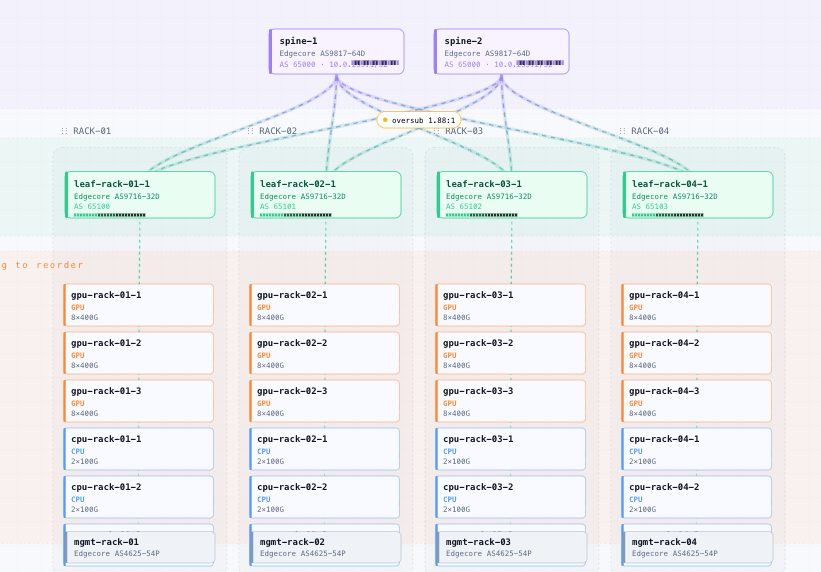
  • Fabric: 2 spines · 2 leaves · 11 edges [Example Illustration only]
  • Storage: object · NVMe · OLAP — kept off the GPU node
CHAPTER 02

Traceability — the horizontal pipeline.

Where the vertical view tells you which layer, the horizontal X-Ray tells you where in the journey. Scroll to walk a real production pipeline — and find the root cause behind the obvious victim.
Pipeline X-Ray v2 b10-resnet-classify Severity: OK SLO RED production-team · anaros-b10 conf 94%
X-RayRateGateGovernorUpdated · 5s ago
PIPELINE EXPLORER   Inter-Stage · AAIF / collector-intelligence · live
GET /api/v1/collector-intelligence
HOST · anavec1-0
↔ intra-node
HOST · anavec1-0
↗ inter-node
HOST · anavec2-0
↗ inter-node
HOST · anavec1-0

INGRESS CPU-NET

cleared susp 23%
CNTR1
EBPFactive
HTTPp99 8761ms
CTRL
IPC
0.3 ms
kernel pipe

PREPARATION CPU-HEAVY

cleared susp 82%
CNTR1
EBPFactive
HTTPp99 8761ms
CTRL
FABRIC
8694 ms
leaf1-0 · Eth80→88

EXECUTION GPU

victim susp 49%
CNTR1
EBPFactive
GPU SM1%
CTRL
FABRIC
2.1 ms
leaf2-0 · Eth88→80

PERSISTENCE STORAGE-OPT

root cause susp 98%
CNTR1
EBPFactive
KERNELFlows —
CTRL
E2E JITTER WATERFALL
Total 19.0ms · measured 4% · unknown 96% (telemetry-gap)
ingress
0.0ms 100%
preparation
6.0ms 51%
staging
5.0ms 38%
execution
0.0ms 100%
post_processing
5.0ms 67%
persistence
6.0ms 59%
01 Visibility · the whole pipeline

The pipeline crosses many boundaries.

This workflow lives on anavec1(GPU) for ingress and preparation, hops across fabric to anavec2(GPU) for GPU execution, then hops back to anavec1 for storage. Pipeline X-Ray sees all of it — intra-node IPC, inter-node fabric, leaf switches, every stage.

  • Boundary kinds intra-node IPC × 1, inter-node fabric × 2
  • Hosts anavec1-0, anavec2-0
  • Switches leaf1-0, leaf2-0
  • Severity OK / SLO RED — symptom and cause diverge
02 Intra-node · inter-process

Where the pipeline hops inside a node.

Ingress and Preparation both live on anavec1 — but they're separate processes in separate containers, talking through a kernel pipe. Most observability stacks lose visibility here. The X-Ray traces it: pipe-buffer occupancy, context switches, container CPU contention.

  • Kind intra-node IPC · kernel pipe buf
  • Latency 0.3 ms · throughput line-rate
  • Context switches 4.2k/s · sched p99 12 µs
  • Container CPU contention yellow on preparation
03 Inter-node · fabric hop

Where the pipeline leaves the host.

Preparation on anavec1 hands off to Execution on anavec2 — across a real fabric edge. Without POFC, this hop goes dark. With POFC, the X-Ray pins it to a specific switch port pair on leaf1-0 and surfaces drift, loss, and ECMP right there.

  • Logical edge preparation → execution
  • Physical path anavec1:enp1s0f0np0 → leaf1-0:Eth80 → Eth88 → anavec2
  • Fabric class ethernet-scale-out · VLAN 10
  • Observed 0.00 Gbps · loss 0 ppm · p99 8694 ms (upstream)
04 POFC · pipeline over fabric

One view that ties pipelines to fabric paths.

Every pipeline edge reconciled with its physical path through leaf/spine. ECMP divergence becomes legible. Ask "where does this workflow live on this fabric?" — and get a topology answer, not a Grafana stack.

  • Topology 2 spines · 2 leaves · 5 hosts · 11 edges
  • Flows 12 active pipeline edges on this fabric
  • Highlighted embedding-amsf-pipeline · anavec3 → anavec2
  • ECMP divergence tracked per (src, dst, pipeline)
05 Foundation · multi-tier telemetry

None of this works without depth.

Six telemetry domains (Node, Kernel, Process, Net L2/L3, TCP, HTTP/L7, gRPC/H2) crossed with six collector layers (SDI/SSH, Prometheus, cAdvisor, eBPF/Beyla, SDK Py/C++, OTel/OTLP). Each phase adds signals — and unlocks new RateGate capabilities.

  • Telemetry layers 6 active on this pipeline
  • End-to-end traces enabled (OTel/OTLP)
  • RateGate unlocked node · switch-port · container · TCP · HTTP · gRPC · GPU-kernel
  • Where it lives AnaROS Pipeline · Multi-tier Telemetry tier
06 Governance · the switch is a first-class object

Leaf1-0, in its own words.

Open the switch and you see POFC signals: resolved endpoints, reconstructions, drifts, violations, latest tick. Verdicts and pending mitigations live next to the switch they apply to, not in a separate ticketing system.

  • Resolved endpoints 2 / 57 — including the affected pipeline
  • POFC reconstructions 2 · hops on switch 2 · drifts 0
  • Latest tick #24282 · 4s ago · ring depth 100
  • Governance posture 0 pending · 0 pending verdicts
07 End-to-end · victim → root cause

Execution is the symptom. Persistence is the cause.

In this example, GPU SM 1% looks like a GPU problem, but the X-Ray correlates intra-node, inter-node, and fabric signals across all stages — and lands on Persistence (suspicion 98%). Storage IOPS contention back-pressures execution upstream all the way to ingress.

  • Victim execution · GPU SM 1% · suspicion 49%
  • Root cause persistence · suspicion 98% · 59% of tail
  • Blast radius 1 pipeline, 2 hosts, 2 leaf switches
  • Auto-action Governor rate-gate · tenant notified
stage detail
live · poll 5s

IngressCPU-NET

PERFORMANCE
p99 latency
8761.0 ms
p95 latency
throughput
0.2 rps
queue depth
METRICS
cntr
1
ebpf
active
http
p99 8761ms
kernel
Flows 115 MB/s
net
Rx 88 MB/s
node
CPU 0%
process
Container CPU —
throughput
122 req/s
Stage is cleared. Suspicion is low — the latency here is upstream backpressure leaking into ingress, not a problem with this stage.
CTRL · open in collector
Fabric POFC View
rack-keyed · pipeline-over-fabric synthesis
switch-spine1-0spine switch-spine2-0spine switch-leaf1-0leaf switch-leaf2-0leaf host-anavec1node host-anavec2node host-anavec3node switch-host1-0node switch-host2-0node
2. FLOWS ON THIS FABRIC
PIPELINESRC → DSTHOPSCLASS
embedding-amsf-pipelineanavec3 → anavec2leaf2-0scale-out
embedding-baselineanavec3 → anavec2leaf2-0scale-out
langgraph-semantic-moeanavec3 → anavec1leaf2-0 → spine1-0 → leaf1-0scale-up
langgraph-semantic-moeanavec1 → anavec2leaf1-0 → spine1-0 → leaf2-0scale-up
b10-resnet-classifyanavec1 → anavec2leaf1-0 → spine2-0 → leaf2-0scale-up
Multi-Tier Collector Intelligence
progressive telemetry depth · root-cause readiness
TELEMETRY LAYERS   SDI/SSH Prometheus cAdvisor eBPF/Beyla SDK Py/C++ OTel/OTLP
NODECPU GPU MEM
KERNELsyscall eBPF
PROCESScontainer
NET L2/L3Rx-Tx-Drop
TCP / PORTconn RTT
HTTP / L7endpoint lat
gRPC / H2stream
System Health
CPU 49%
GPU SM 1%
ctx switches
sched lat
Container CPU
OOM events
Memory
total/avail
GPU VRAM
page faults
TLB miss
container RSS
Storage
disk IOPS
write lat p99
block I/O lat
blkio stall
container blkio
Net Fabric
NIC IRQ rate
net Rx/Tx
port Rx/Tx
drop+ECN
TCP / Conn
TCP retrans
socket backlog
RTT p50/p99
HTTP / L7
eBPF intercept
reqs/endpoint
p99 latency
gRPC status
GPU / Accel
GPU SM util
VRAM used
CUDA events
PCIe BW
tokens/s
batch size
Queue / BP
kernel pipe buf
net queue
TCP send buf
app queue depth
gRPC flow window
SDI/SSH Prometheus cAdvisor eBPF/Beyla SDK Py/C++ OTel/OTLP
Switch detail · leaf1-0
POFC observation + governance · last tick 4s ago
Identity
SIDleaf1-0
Mgmt IP10.110.3.25:8080
Ports67
StateActive
POFC Signals
Resolved endpoints2 / 57
Reconstructions2
Hops on switch2
Drifts0
Latest tick#24282 · 4s ago
Governance Posture
PENDING
0
HISTORICAL
0
PENDING VERDICTS
0
RESOLVED ENDPOINTS · 2 of 2
PIPELINEEDGEPORTSBOUND
langgraph-semantic-moepreparation → executionleaf1-0:Eth80 → leaf2-0:Eth80✓ bound
langgraph-semantic-moepost_proc → persistenceleaf2-0:Eth88 → leaf1-0:Eth80✓ bound
CHAPTER 03

Governance — live resource map.

Every GPU, every loaded model, every active pipeline — visible and attributable. Ledger contract versus reality, in real time.
B14 Resnet Classify ×
HOT 8 WARM 4 COLD 14
LIVE
RESOURCE MAP · TWEAKS
lightdark
Cluster topology
Overlay
Ledger contract (ghost)
Contention badges
Node utilization fill
Flow particles
Flow speed 1.2×
LEAF
switch-sonic-as4625
SONiC · 54×1GMGMT
anavec1 · 192.168.9.155· DGX
CPU HEAD NODE
CPU0
20c
NVMe0
NVMe1
NIC0
NIC1
BMC
GPU TRAY · 1×GB10
GPU #0 · GB10 · 119GB36%
vram 42.85 / 119 GB36%
2 models loaded · GPU 18% · SM 12%
MEMORY · 119GB unified
42.85 / 119 GB36%
LOADED MODELS · 2
WARMQwen/Qwen3-8B
COLDTinyLlama/Chat-v1.0
PIPELINES · 12 active
healthy · ssh+nvidia-smi · 5s ago
anavec2 · 192.168.9.156· DGX
CPU HEAD NODE
CPU0
20c
NVMe0
NVMe1
NIC0
NIC1
BMC
GPU TRAY · 1×GB10
GPU #0 · GB10 · 119GB55%
vram 65.75 / 119 GB55%
3 models loaded · GPU 28% · SM 22%
MEMORY · 119GB unified
65.7 / 119 GB55%
LOADED MODELS · 3
WARMQwen/Qwen3-32B
COLDQwen/Qwen2.5-1.5B-Instruct
COLDTinyLlama/Chat-v1.0
PIPELINES · 18 active
healthy · ssh+nvidia-smi · 5s ago
anavec3 · 192.168.9.157· DGXselected
CPU HEAD NODE
CPU0
20c
NVMe0
NVMe1
NIC0
NIC1
BMC
GPU TRAY · 1×GB10 · executing B14
GPU #0 · GB10 · 119GB30%
vram 36.18 / 119 GB30%
1 model loaded · GPU 2% · SM 1%
MEMORY · 119GB unified
36.2 / 119 GB30%
LOADED MODELS · 1
HOTmicrosoft/resnet-50 (B14 active)
PIPELINES · 19 active
healthy · ssh+nvidia-smi · 5s ago
GPU · #0 · GB10
server-anavec3 · gpu-anavec3-0
2%
GPU UTIL
30%
VRAM UTIL
30%
MEM UTIL
FABRIC BANDWIDTH
Scale-Up
ethernet · intra-rack
0 / 1 Gbps
Scale-Out
ethernet · cross-rack
0 / 1 Gbps
MODELS · 1 LOADED
HOTmicrosoft/resnet-50B14
182 MB · loaded 14h ago
PIPELINES · 19
B14 Resnet Classify ▸ exec
+ Adaptive Rag App, B10-B13, B15-B16, …
B14 · LEDGER vs REALITY SYNTHESIZED
ledger
actual
GPU-hrs
9.5
0.078
Bandwidth
0.31 Gbps
0.248 Gbps
contract gap · synthesized until ledger_claims × xray
PATH · 3 HOPS
LEAF
switch-sonic-as4625
ingress
0%
SERVER
anavec3
compute
0%
GPU #0
GB10
execute
2%
CHAPTER 04

Placement — workloads on the right silicon.

Heavy CNN/ViT inference, MoE expert layers, and agentic pipeline stages don't all need an H200. AnaROS routes each stage to the cheapest GPU class that holds its SLO — heterogeneous by design.
One inspection pipeline, four stages, four different GPU classes — and one governance plane on top.
INSPECTION PIPELINE · UNIT OF WORK
amsf:inspection-b6-amsf · production-team
STAGE 1

Image Ingest

L4PCIe
NIC + storage bound
host · anavec1-0
STAGE 2

Tile / Pre-process

L40SPCIe
normalize, augment, batch
host · anavec1-0
STAGE 3

Defect Inference

H200SXM
heavy CNN / ViT
host · anavec2-0
STAGE 4

Classify / Dispose

T4PCIe
small classifier, final decision
host · anavec3-0
AnaROS™ — Pipeline Governance Layer — SLOs · Isolation · Routing · Chargeback PIPELINE-AWARE
WORKFLOW PLACEMENT JOURNEY
workflow: amsf:inspection-b6-amsf
01 · DISCOVER
Discover
5 containers declared · source workflow_intent.yaml
02 · RECONCILE
Reconcile
declared shape bound · strategy per_container
03 · PLACE
Place
stages routed to L4 · L40S · H200 · T4 · advisory plan ready
04 · DEPLOY
Deploy
deploy state pending · Terraform walkthrough on apply
05 · GOVERN
Govern
SLOs, isolation, chargeback wire after deploy
RESOURCE MAP · LIVE SNAPSHOT
advisory only — no commit until Apply
anavec1
unified
gpu-anavec1-0
111.1 GB free
cap 128 · used 16.9 (87% free)
8 models loaded
anavec2
unified
gpu-anavec2-0
106.9 GB free
cap 128 · used 21.1 (84% free)
2 models loaded
anavec3
unified
gpu-anavec3-0
123.3 GB free
cap 128 · used 4.7 (96% free)
2 models loaded
⚡ Apply this plan · Terraform Deploy walkthrough
One rack operating system. One runtime. One storyline.

Visibility → Traceability → Governance → Placement, all on the same governed pipeline. The same AnaROS console runs on your homelab today.

Next step · Instrument · Profile · Pilot Request a briefing hello@anavec.ai